 als
alsMenu
News and Events
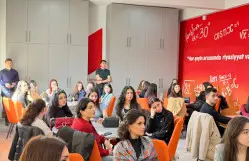
The Psychological Support Sector of Baku State University organized a seminar for academic staff and students titled “Choices that define our lives – human boundaries in existential psychology.”
The seminar featured psychologists Natavan Hasan-zada and Adem Pashayev, who noted that existential psychology is a field that examines fundamental human issues such as the meaning of life, freedom, responsibility, fear of death, and loneliness. They provided extensive insights into the role of personal choices, as well as the concepts of individual responsibility and freedom within this psychological framework.
It was emphasized that the choices individuals make at different stages of life are among the key factors shaping their life paths and personal development. In many cases, people tend to perceive themselves as victims of circumstances, struggle with decision-making, and attribute responsibility to external factors. However, according to existential psychology, individuals possess the freedom to choose, which inherently entails responsibility. Thus, making a choice involves not only acting freely but also accepting the consequences of one’s thoughts and actions.
Participants discussed psychological defense mechanisms, internal fears, and subconscious thoughts that influence decision-making processes. The psychologists noted that recognizing and analyzing these mechanisms helps individuals better understand themselves and make more conscious life choices.
It was also highlighted that even the avoidance of making a choice is, in itself, a form of choice. Therefore, it is essential for individuals to adopt an active approach to life and acknowledge responsibility for their decisions.
The seminar was conducted in an interactive format, allowing participants to exchange ideas and discuss various real-life situations. At the end of the event, students were given psychological practical tasks to encourage deeper reflection and application to their personal lives, and their questions were addressed.
SDG 3 (Good Health and Well-being), SDG 4 (Quality Education), SDG 8 (Decent Work and Economic Growth)