 als
alsMenu
News and Events
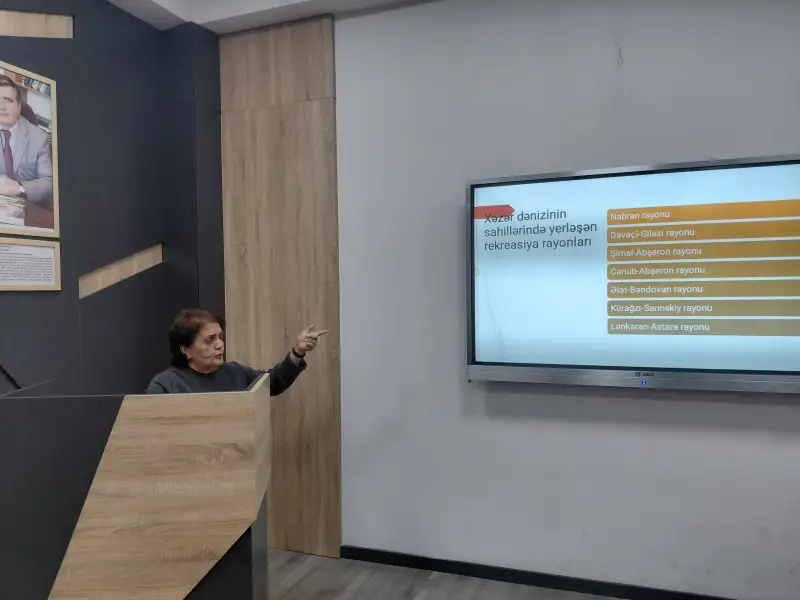
A scientific seminar titled “Assessment of Hydrometeorological Parameters in the Recreational Zones of the Caspian Sea” was held at the Faculty of Geography of Baku State University (BSU).
Speaking at the seminar, Head of the Department of Azerbaijan Geography and Methods of Teaching Geography, Associate Professor Saleh Nagiyev, emphasized the importance of scientifically assessing the recreational potential of the Caspian Sea and studying the impact of hydrometeorological factors on the recreational environment for the sustainable development and efficient use of coastal areas. He noted that Aytan Guliyeva, a lecturer at the Department of Hydrometeorology and PhD in Geography, is a specialist in the field and conducts research on the influence of hydrometeorological processes on natural and recreational systems.
In her presentation, Aytan Guliyeva provided a detailed overview of the natural and geographical characteristics of the Caspian Sea’s recreational zones, key hydrometeorological indicators observed in these areas, and their seasonal variability. The study analyzed air temperature, wind regime, humidity, precipitation, wave height, and other hydrometeorological parameters, assessing their impact on recreational activities. The role of hydrometeorological factors in shaping recreational conditions, identifying risk factors, and determining favorable periods in the coastal zones of the Caspian Sea was examined using scientific and statistical approaches.
During the seminar, professors Maqsad Gojamanov and Aydin Ibrahimov, associate professors Irada Aliyeva and Alakbar Hasanaliyev, and other participants highlighted the relevance of the research and emphasized the innovative nature of its methodological approach.
SDG 13 (Climate Action), SDG 14 (Life Below Water), SDG 11 (Sustainable Cities and Communities), SDG 4 (Quality Education)