 als
alsMenu
News and Events
Properties of metal nanoparticles obtained using aromatic wormwood plant are being studied at BSU
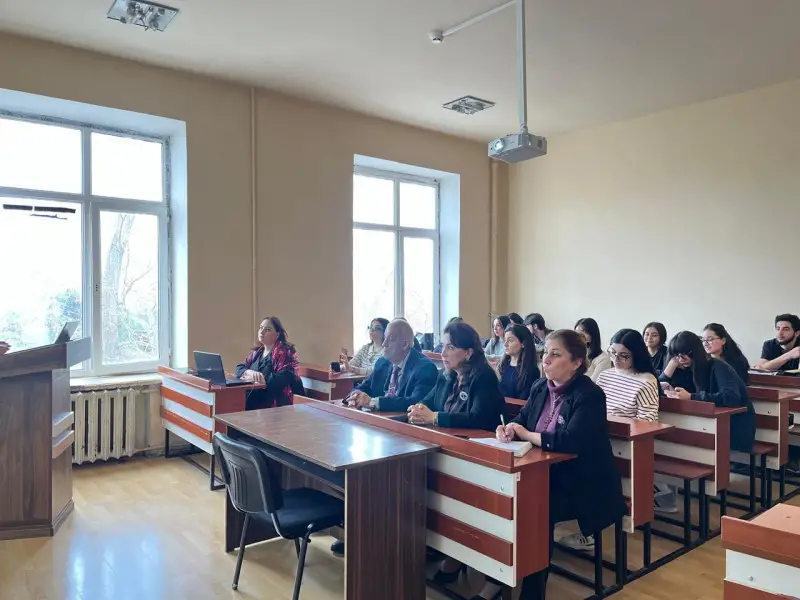
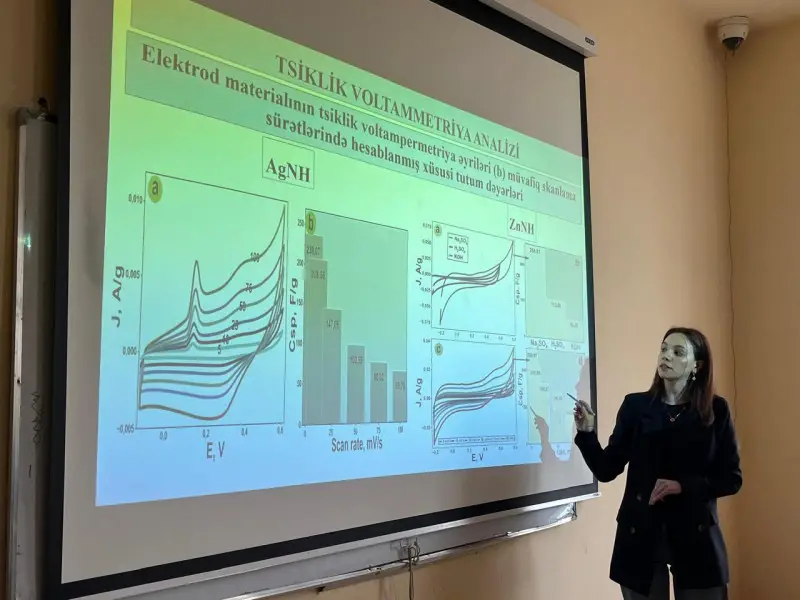
A scientific seminar titled “Investigation of the physico-chemical properties of metal nanoparticles obtained using the aromatic wormwood (Artemisia lerchiana Web.) plant” was held at the Faculty of Biology of Baku State University (BSU). The report was delivered by Gunay Hasanova, a doctoral student of the Department of Biophysics and Biochemistry.
It was noted that within the framework of the research, silver (Ag) and zinc (Zn) nanoparticles were synthesized using an extract of the aromatic wormwood plant through an environmentally friendly “green synthesis” method, and their physico-chemical properties were comprehensively studied. The main objective of the study was to determine the structural, optical, morphological, and electrochemical characteristics of the synthesized nanomaterials.
During the research, modern analytical methods were employed, including UV–Vis spectroscopy, FTIR analysis, X-ray diffraction (XRD), electron microscopy (TEM and SEM), atomic force microscopy (AFM), thermal analyses (TGA–DTA), EDX elemental analysis, zeta potential and particle size analysis, as well as electrochemical techniques such as CV, GCD, and EIS.
The results demonstrated that the synthesized nanoparticles were formed within the nanoscale range and possessed stable physico-chemical properties. According to TEM analysis, the size of silver nanoparticles ranged from 4–19 nm, while zinc nanoparticles were approximately 50 nm in size. SEM results indicated size ranges of 25–50 nm for Ag and 50–70 nm for Zn.
It was emphasized during the seminar that electrochemical analyses revealed high activity and low internal resistance of the obtained materials. This increases their potential applications in areas such as energy storage systems, sensor technologies, and catalytic processes.
The findings also confirmed that the green synthesis method is an environmentally safe, efficient, and promising approach for obtaining nanomaterials. The seminar included extensive discussions on green nanobiotechnology, environmentally safe synthesis methods, and application prospects of nanomaterials.
SDG 4 (Quality Education), SDG 9 (Industry, Innovation and Infrastructure), SDG 13 (Climate Action)