 als
alsMenu
News and Events
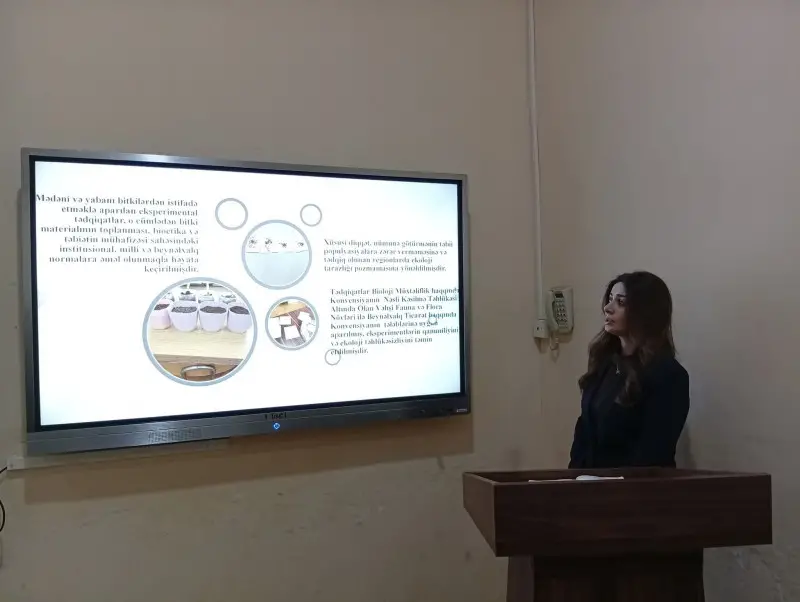
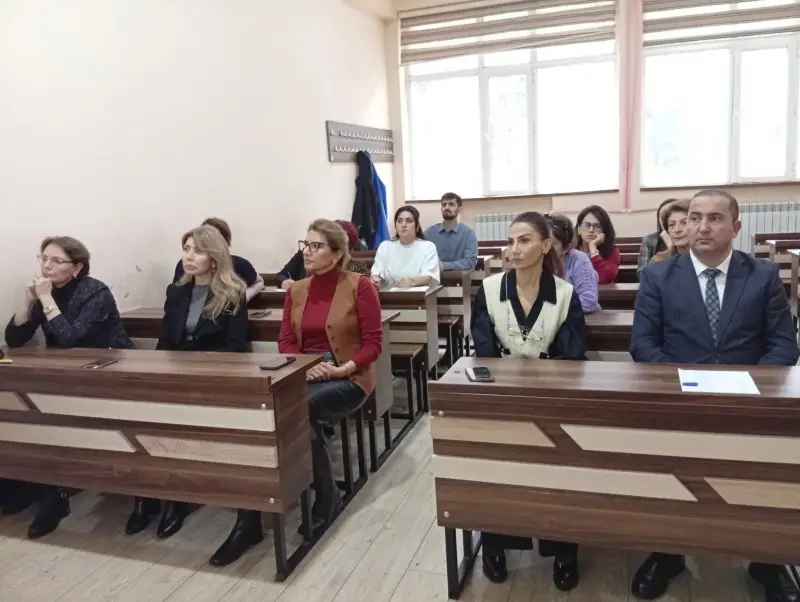
Doctoral student Laman Guliyeva from the Department of Bioecology at the Faculty of Ecology and Soil Science of Baku State University (BSU) delivered a presentation at a scientific seminar on the topic “Assessment of the Assimilation Potential of Coastal Landscapes of the Caspian Sea under Technogenic Impacts.”
The researcher aimed to determine the resistance level of soils located in the coastal zone of the Caspian Sea to technogenic pollution by analyzing their physical-chemical and biological characteristics. The study focused on examining microbiological activity in coastal soil types, indicators of hydrocarbon biodegradation, mineralization coefficients, assimilation potential, and the self-purification capacity of soils.
During the research, the total number of microorganisms, the development dynamics of oil-degrading microorganisms, and respiration intensity were compared across different soil types (meadow-forest, gray-meadow, and gray-brown). In addition, soil phytotoxicity was assessed using Medicago sativa L. and Lepidium sativum L. as test plants.
The findings demonstrated that a systematic analysis of biotic and abiotic factors in coastal landscapes plays a crucial role in assessing soil assimilation potential. Moving northward, soil biogenicity and mineralization coefficients increase, which accelerates the decomposition rate of pollutants. Comparative analysis showed that meadow-forest soils possess the highest assimilation capacity, while gray-meadow and especially gray-brown soils exhibit weaker self-recovery potential.
The researcher emphasized that in soils more sensitive to pollution, the application of modern biotechnologies is of particular importance to enhance natural self-purification processes and assimilation potential, as well as to increase environmental resilience in cases of organic contamination. This is especially relevant for the sustainable management of coastal ecosystems.
At the end of the seminar, the presenter answered participants’ questions, followed by an exchange of scientific views.
SDG 4 (Quality Education), SDG 13 (Climate Action), SDG 14 (Life Below Water), SDG 15 (Life on Land)