 als
alsMenu
News and Events
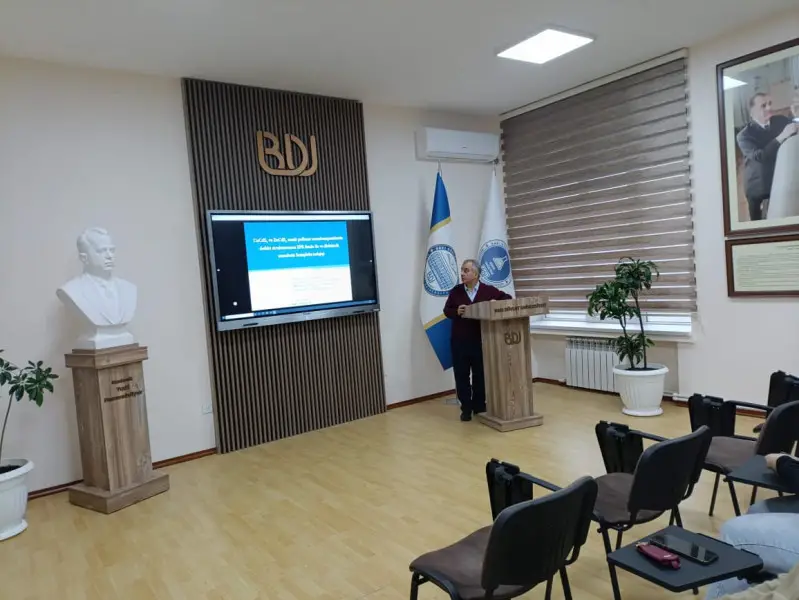
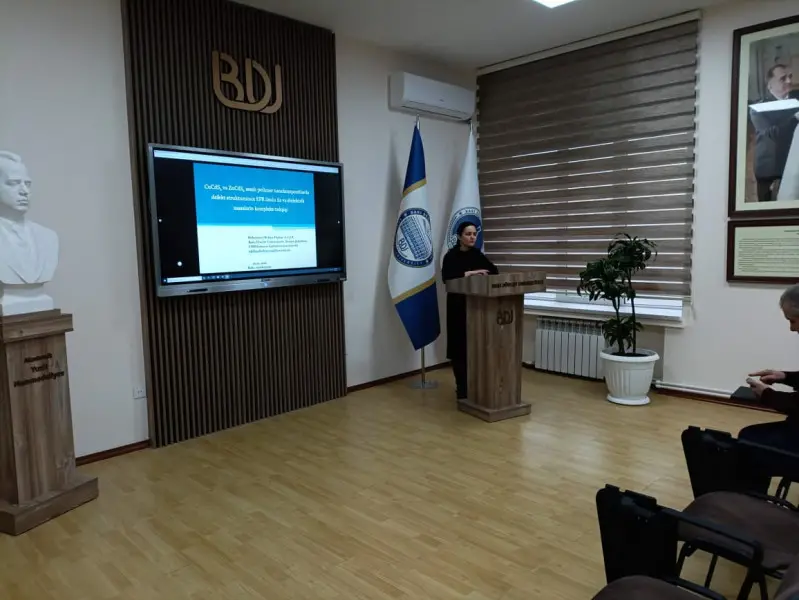
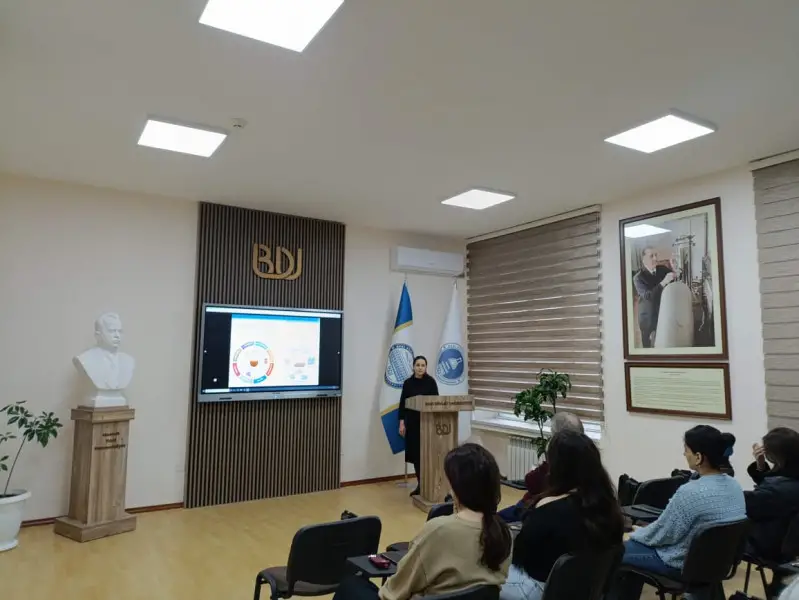
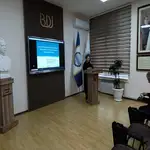
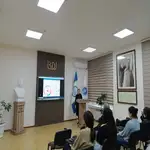
A scientific seminar dedicated to Science Day was held at the Department of Macromolecular Compounds Chemistry of the Faculty of Chemistry at Baku State University. The seminar was presented by Associate Professor Ofeliya Balayeva and focused on “Comprehensive Investigation of Defect Structure by EPR Method and Dielectric Properties of CuCdS₂- and ZnCdS₂-Based Polymer Nanocomposites.”
The event began with a minute of silence in memory of the victims of the Khojaly tragedy and Azerbaijan’s martyrs. Opening the seminar, Head of the Department Professor Rasim Alosmanov welcomed the participants and emphasized the importance of Science Day and the relevance of the research topic.
In her presentation, Ofeliya Balayeva discussed the application prospects of CdS/FNK, ZnS/FNK, CuS/FNK, CdZnS₂/FNK, and CuCdS₂/FNK nanocomposites, which exhibit high crystallinity, favorable optical properties, and strong thermal and mechanical stability. She noted that these materials have significant potential for use in solar panels, photosensitive semiconductor devices, and gas sensors, making them an important area of research in nanochemistry.
The seminar provided detailed information on studies in which CuCdS₂ and CdZnS₂ ternary compound nanocrystals were synthesized within a polymer matrix using the SILAR method. Surface defects and size-related effects of the nanoparticles were analyzed using Electron Paramagnetic Resonance (EPR), X-ray Diffraction (XRD), and UV spectroscopy techniques. The research demonstrated that although zinc and cadmium sulfides are typically diamagnetic, surface defects and nanoscale effects can lead to the formation of paramagnetic centers. New signals observed under high magnetic fields were examined and interpreted.
Particular attention was given to the broad, asymmetric, singlet EPR signal detected in the CdS/FNK nanocomposite, which exhibited isotropic symmetry. The wide band-gap energy identified for CuCdS₂/FNK nanocomposites (approximately 3.7 eV) was attributed to the formation of nanoparticles within the confined volume of the polymer matrix and to quantum size effects.
The findings highlighted the potential application of the synthesized nanocomposites in solar energy technologies, photosensitive semiconductor devices, and gas-sensing systems. It was also emphasized that CuCdS₂ nanoparticles, due to their wide band-gap energy, could serve as promising materials for high-energy electronic devices, light-emitting diodes (LEDs), and semiconductor lasers.
The seminar concluded with discussions and a question-and-answer session.
SDG 4 (Quality Education), SDG 7 (Affordable and Clean Energy), SDG 9 (Industry, Innovation and Infrastructure), SDG 11 (Sustainable Cities and Communities), SDG 13 (Climate Action)