 als
alsMenu
News and Events
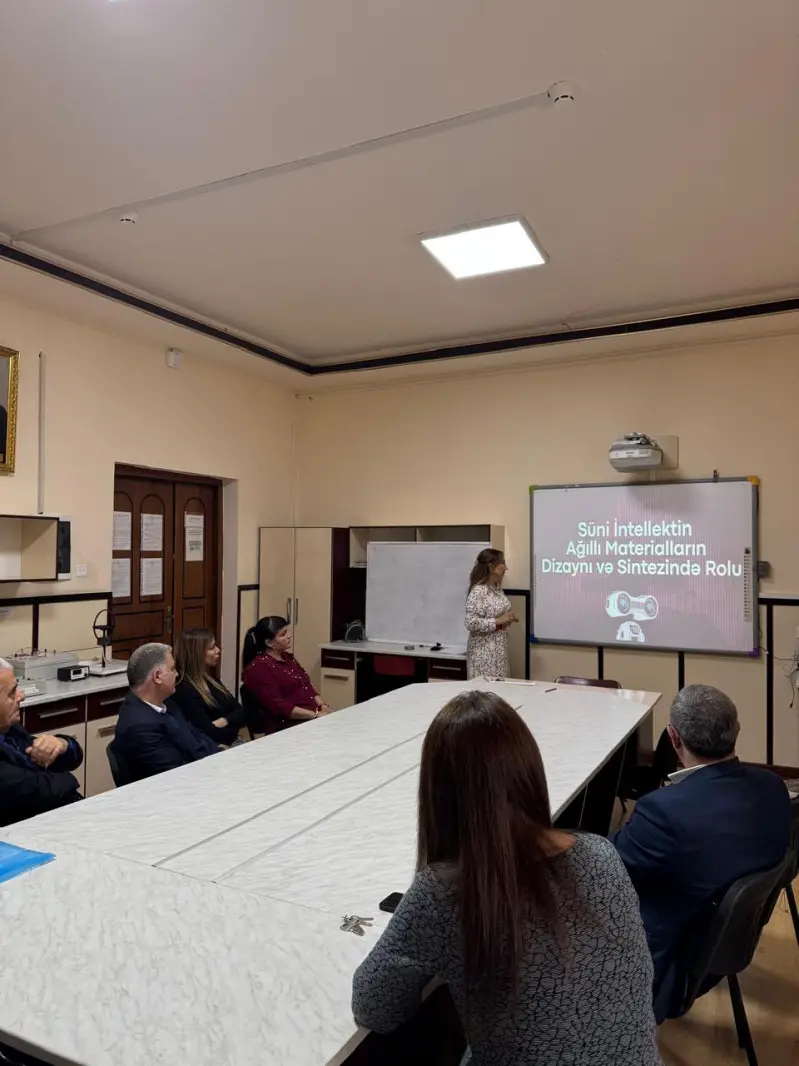
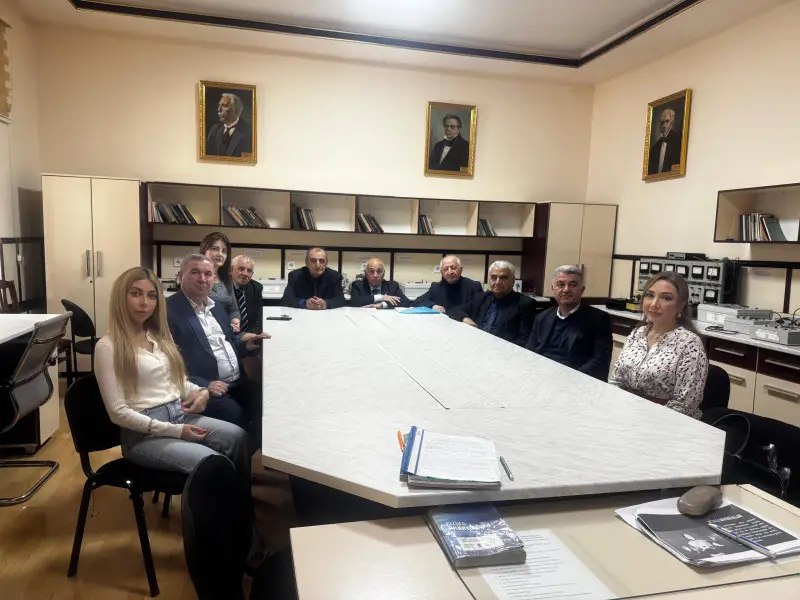
On 24 October 2025, the next scientific seminar of the Department of General Physics and FTM was held. At the seminar, Aida Ahmadova, a faculty member, delivered a presentation on “Artificial Intelligence – From Micro Scales to Macro Results.”
The speaker noted that artificial intelligence (AI) mainly consists of systems based on statistical analysis and mathematical models. However, its ability to understand and predict physical phenomena is governed by a number of laws. There is an interaction between nanotechnology and AI. Nanotechnology is primarily built on the principles of quantum physics, statistical mechanics, and electrodynamics. AI, in this field, is mainly applied in material research, nano-robot technologies, and optoelectronics. Quantum mechanics forms the fundamental basis of nanotechnology because the behavior of matter at the atomic and molecular level follows laws different from classical physics. The de Broglie hypothesis states that matter has both particle and wave properties. AI processes large volumes of experimental data related to quantum mechanics to optimize the design of new materials and devices. As a result, quantum mechanics forms the foundation of nanotechnology, and AI helps develop more effective models and applications in this field.
There are three main types of machine learning methods:
-
Supervised Learning – the model is trained using pre-labeled data.
-
Unsupervised Learning – the model independently identifies patterns and structures in the data.
-
Reinforcement Learning – the system learns to make optimal decisions based on a reward and punishment mechanism.
The application of machine learning in nanotechnology enables the modeling of new materials and a deeper analysis of physical laws. AI plays a significant role in the design and synthesis of smart materials. Smart materials can respond to environmental changes (temperature, pressure, light, magnetic field, etc.) and sometimes exhibit behaviors adapted to these stimuli. These materials can include self-healing, shape-changing, or reactive structures.
Nanotechnology is fundamentally transforming diagnostic and therapeutic methods in medicine:
-
Nanorobots: Small devices that can move through the bloodstream to detect and destroy cancer cells.
-
Targeted Drug Delivery: Nanotechnology enables drugs to be directed specifically to affected tissues, reducing side effects.
-
Brain-Computer Interfaces: AI and nanotechnology are used together for neural research and analysis of brain signals.
Nanotechnology also creates innovative solutions in industry and energy:
-
Supercapacitors and Nanobatteries: Nanomaterials are used to enable faster energy storage and longer lifespans.
-
Enhanced Efficiency in Solar Panels: Nanotechnology improves light absorption in solar panels.
-
Nanofilters Against Pollution: Nanotechnology is applied in water and air filtration systems to remove harmful particles.
Nanotechnology and AI contribute significantly to scientific development based on fundamental laws of physics. The study of the structure and properties of nanomaterials is explained by the principles of quantum mechanics. Machine learning accelerates the processes of synthesis and analysis of new materials. Applications of nanotechnology in nanomedicine, energy, and industry open up great prospects for future development. The integration of these two fields is expected to provide one of the greatest technological breakthroughs in the future.
SDG 4 (Quality Education), SDG 17 (Partnerships for the Goals)