 als
alsMenu
News and Events
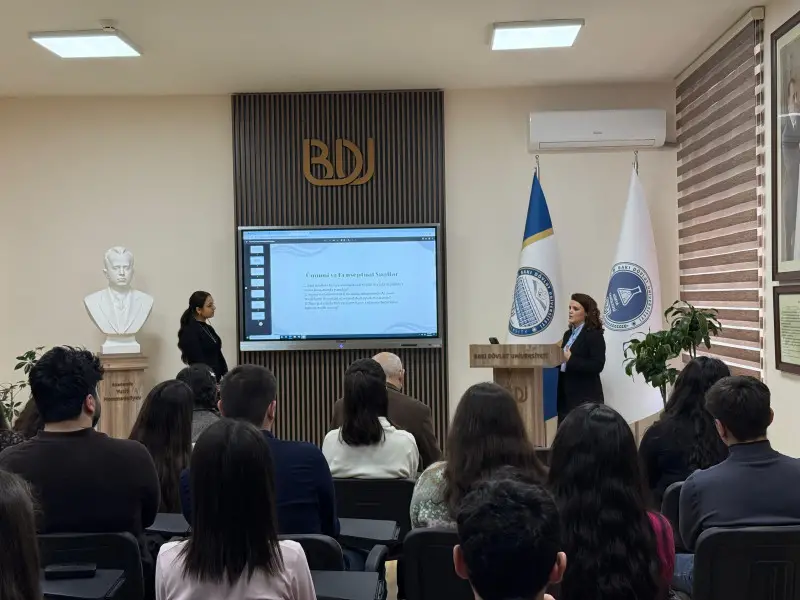
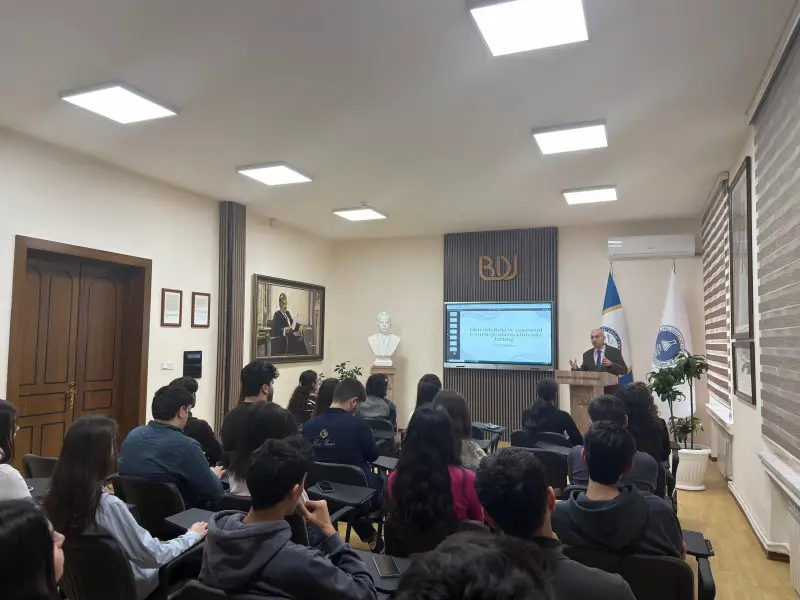
A scientific seminar dedicated to Science Day in the Republic of Azerbaijan, observed on 27 March, was organized by the Student Scientific Society of the Faculty of Chemistry at Baku State University.
The event began with a minute of silence in memory of the victims of the Khojaly tragedy. Taleh Gahramanov, Deputy Dean for Social Affairs and Student Relations of the Faculty of Chemistry, spoke about the tragedy and its lasting significance in the history of Azerbaijan. He also highlighted the importance of the seminar and introduced the guest speaker, emphasizing the growing role of artificial intelligence in optimizing chemical processes, analyzing data, and developing innovative solutions.
The seminar featured a presentation by Aynur Zeynalova, a representative of SOCAR Downstream, on the topic “The Application of Artificial Intelligence and Digital Technologies in Chemistry.” She provided detailed insights into the role of artificial intelligence tools in modern chemistry, the integration of digital technologies into scientific research, and their industrial applications.
During her presentation, Aynur Zeynalova explained that one of the most transformative impacts of artificial intelligence in chemistry is its ability to process large volumes of data rapidly, model complex systems, and optimize processes. She noted that AI-based models can save significant time and resources compared to traditional methods, while emphasizing that reliable results still depend on high-quality data and expert supervision.
The speaker discussed the use of artificial intelligence in areas such as molecular design, smart laboratories, computational chemistry, industrial process optimization, green and sustainable manufacturing, as well as applications in the petrochemical and pharmaceutical industries. She stressed that artificial intelligence is not a replacement for chemists but rather a tool that enhances their work. According to her, laboratories of the future will become increasingly automated and digitalized, making the development of digital competencies essential for young researchers.
The event continued with interactive discussions and a question-and-answer session. The seminar was well received by participants and contributed to increasing interest in science, particularly in the application of digital technologies and artificial intelligence in chemistry.
SDG 4 (Quality Education), SDG 8 (Decent Work and Economic Growth), SDG 9 (Industry, Innovation and Infrastructure), SDG 12 (Responsible Consumption and Production), SDG 17 (Partnerships for the Goals)