 als
alsMenu
News and Events
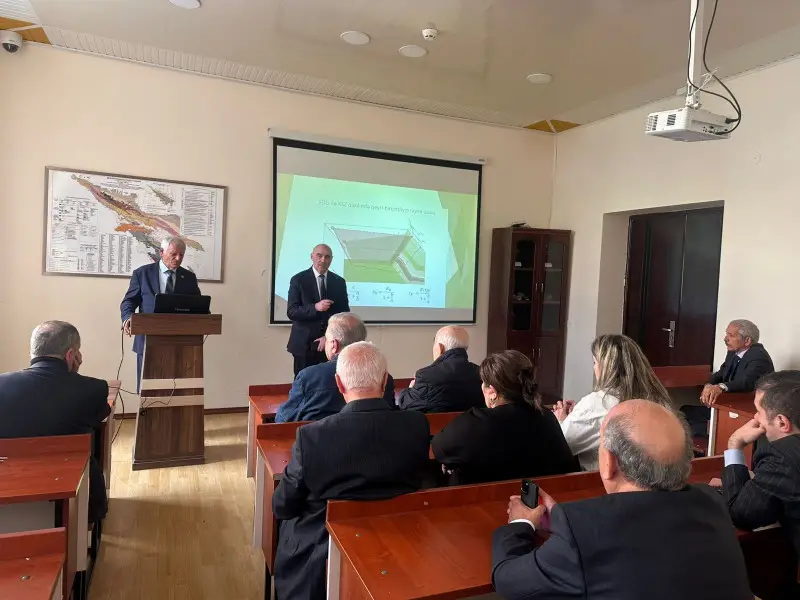
A scientific seminar on the topic “the relevance of studying low-velocity zones in urban planning” was held at the Faculty of Geology of Baku State University (BSU) within the framework of the “year of urban planning and architecture.”
The seminar addressed modern challenges in geophysics and seismology, once again highlighting the importance of considering the physical properties of the Earth’s subsurface in urban development processes.
Dean of the Faculty, Mamoy Mansurov, spoke about the importance of grounding urban development policies in scientific research, emphasizing the necessity of safe and sustainable construction practices, particularly in seismically active regions. He noted that modern urban planning should be based not only on architectural and design approaches but also on the results of geological and geophysical studies.
The main speaker, Associate Professor Ali Novruzov from the Department of Seismology and Physics of the Earth’s Interior, delivered a presentation on the topic. He explained the structure of the Earth’s interior, the propagation characteristics of seismic waves, and the engineering-geological interpretation of variations in wave velocity.
It was noted that zones of reduced seismic wave velocity, known as low-velocity zones, may indicate weak mechanical properties of rocks, high porosity and fracturing, and varying levels of water saturation. These conditions may create additional risks during construction activities. Early detection and mapping of such zones play an important role in preventing future deformations, subsidence, and other geodynamic processes.
The speaker also highlighted that modern geophysical methods, including seismic tomography, ground-penetrating radar, and other innovative approaches, enable more precise analysis of the Earth’s subsurface. In addition, the use of artificial intelligence technologies for processing and analyzing large datasets opens new perspectives in this field and improves decision-making efficiency.
During discussions, special attention was given to expanding the application of geophysical research in urban planning practice, strengthening specialist training, and integrating scientific results into practical implementation.
SDG 4 (Quality Education), SDG 9 (Industry, Innovation and Infrastructure), SDG 11 (Sustainable Cities and Communities)