 als
alsMenu
News and Events
A scientific seminar dedicated to April 18 – the International day for Monuments and Sites was held at Baku State University (BSU), jointly organized by the university’s history museum and the Faculty of History.
Moderator of the event, director of the BSU history museum Gunel Orujaliyeva, provided information about the history of this day, noting that it was established by UNESCO in 1983 and is also observed in Azerbaijan. She highlighted that various events, excursions, and exhibitions are organized annually to promote the protection of monuments and historical sites.
Associate professor Kamala Najafova, deputy dean for scientific affairs of the Faculty of History, spoke about the projects implemented in Azerbaijan for the restoration and preservation of historical monuments, as well as ongoing efforts to safeguard them for future generations. She also emphasized the importance of jointly organized events of this kind.
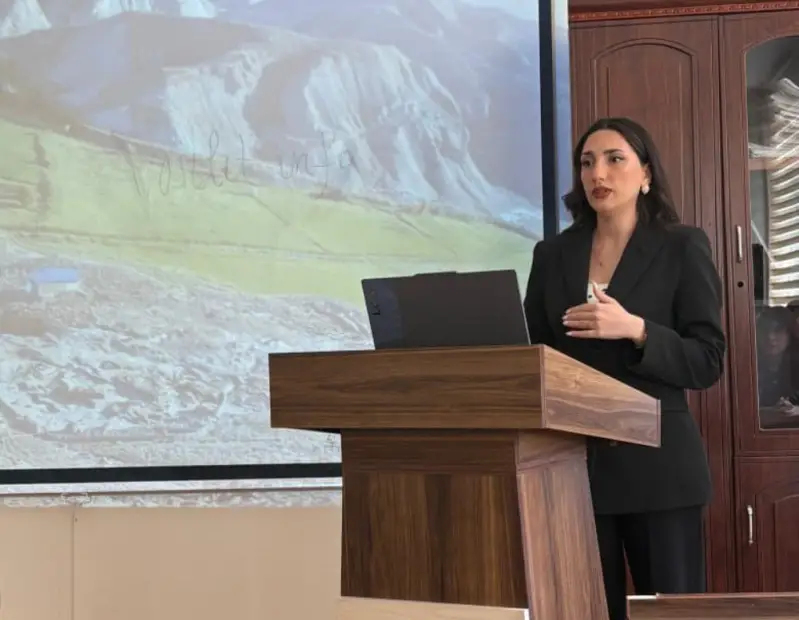
Later, lecturer of the Department of Archaeology and Ethnography Gunay Bayramova Mirzazade delivered a detailed presentation on the topic “burial traditions of the Plovdag necropolises.” The report analyzed the results of recent archaeological research related to the late Bronze and early Iron Ages. It was noted that the Plovdag necropolises are an archaeological complex located on the left bank of the Gilanchay River in the Ordubad region of the Nakhchivan Autonomous Republic. The complex includes a settlement from the early Bronze Age and three large necropolises covering different stages of the Bronze Age.
Archaeological excavations conducted in 2020 revealed a jar burial in the wall of a Bronze Age settlement. Numerous stone box graves discovered in the necropolis, along with materials from nearby sites such as Munjuglutepe, Mardangolu, and Khali-Keshan, are of significant importance for understanding burial traditions from the mid-second millennium BC to the early first millennium BC. Various artifacts, including pottery, weapons, and ornaments made of bronze, bone, semi-precious stones, shells, and cowries, were uncovered.
Head of the Department of Archaeology and Ethnography, Doctor of Historical Sciences Tarikh Dostiyev, emphasized that Azerbaijan possesses a rich history and ancient cultural heritage, with many monuments and architectural examples of international importance. He noted that recent archaeological research has significantly contributed to presenting Azerbaijan’s historical heritage to the global scientific community through solid academic publications.
The presentation was met with great interest by the audience and concluded with extensive discussions.
SDG 4 (Quality Education), SDG 11 (Sustainable Cities and Communities), SDG 16 (Peace, Justice and Strong Institutions)