 als
alsMenu
News and Events
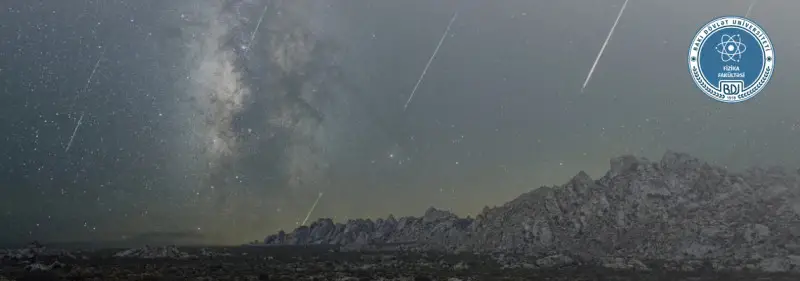
The Department of Astrophysics at the Faculty of Physics of Baku State University (BSU) has announced that the Alpha Capricornids meteor shower will be visible at the end of July.
According to the department, the meteor shower will remain active from early July until 15 August, reaching its peak on 30 July at 17:00 (Baku time). The most favorable viewing conditions in Azerbaijan are expected on the night of 30–31 July.
The shower's radiant is located in the constellation Capricornus. Since the radiant remains above the horizon throughout the night as seen from Baku, meteors can be observed continuously, with the best viewing conditions occurring around 1:00 a.m., when the radiant reaches its highest point in the sky.
Under ideal dark-sky conditions, the Zenithal Hourly Rate (ZHR) is expected to reach about five meteors per hour. However, because the radiant rises to only about 39° above the horizon in Baku, observers are likely to see an average of three meteors per hour.
This year's observations will be affected by the Moon, which will be just two days past its full phase during the shower's peak. The bright moonlight is expected to reduce the visibility of faint meteors. Nevertheless, the Alpha Capricornids are well known for producing bright fireball meteors with long luminous trails, making spectacular observations still possible.
The meteors enter Earth's atmosphere at a relatively slow speed of approximately 23 km/s (about 82,800 km/h), making them easier to observe than many other meteor showers.
The Alpha Capricornids originate from the periodic comet 169P/NEAT, which completes one orbit around the Sun every 4.2 years and belongs to the Jupiter-family comets. Dust particles released by the comet in previous orbits continue to intersect Earth's orbit, producing the annual meteor shower.
The department noted that no telescope or binoculars are required to observe the event. The best viewing conditions can be found in dark locations away from city lights with an unobstructed view of the sky. Observers are also advised to look about 30–40 degrees away from the radiant, rather than directly at it, to maximize the number of visible meteors.
SDG 4 (Quality Education), SDG 9 (Industry, Innovation and Infrastructure).