 als
alsMenu
News and Events
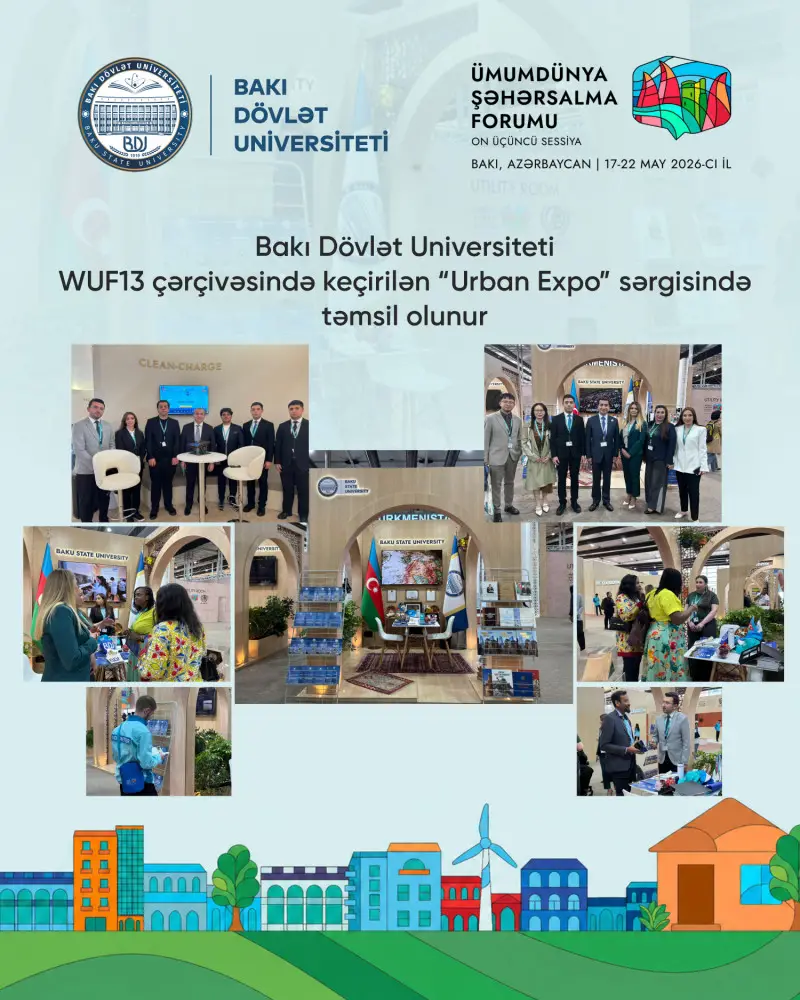
On May 18, the official opening ceremony of the “Urban Expo” exhibition was held within the framework of the 13th session of the World Urban Forum (WUF13) organized by the United Nations. The event was attended by Anar Guliyev, Chairman of the State Committee for Urban Planning and Architecture of the Republic of Azerbaijan and National Coordinator for WUF13, as well as Anacláudia Rossbach, Executive Director of UN-Habitat.
Covering an area of 3.5 hectares, the “Urban Expo” exhibition serves as a global platform bringing together more than 217 organizations from 66 countries to showcase advanced practices in urban planning and sustainable development. Dedicated to the theme “Housing for All: Safe and Sustainable Cities and Human Settlements,” the exhibition provides broad opportunities for cooperation among governments, academic institutions, civil society organizations, and private sector representatives.
Baku State University is actively represented at the exhibition. The university’s exposition highlights scientific research projects and initiatives focused on sustainable urban development, preservation of ecological balance, adaptation to climate change, application of innovative technologies, formation of inclusive urban development models, and the establishment of land cadastre database systems.
The materials presented by BSU representatives place particular emphasis on scientific approaches to key urban challenges, smart city concepts, opportunities for digital transformation, and multidisciplinary research aimed at developing more sustainable and human-centered urban infrastructure. Visitors are also introduced to the practical applications of research conducted at various faculties and scientific centers of the university, as well as joint international projects and partnership initiatives.
Within the “Urban Expo,” the “Business and Innovation Hub” platform also features 45 companies and 14 startup projects. A prototype of the “Clean-Charge” EcoEnergy station, developed by the Student Scientific-Technical Creativity Center of Baku State University and implemented on the university campus, occupies a special place at the exhibition.
This hybrid energy system, with a total capacity of 22 kilowatt-hours, uses renewable sources such as solar and wind energy to supply power to electric vehicles. The main goal of the project is to ensure electricity production exclusively from clean energy sources and thereby contribute to reducing indirect carbon emissions. Implemented on the university campus with grant support from KOBIA and scientific-technical participation from BSU, this innovative ecological initiative serves as a model for the application of modern green technologies. Currently, the “Clean-Charge” EcoEnergy station is actively used daily by electric vehicle drivers and contributes practically to the development of sustainable energy infrastructure.
BSU’s participation in this prestigious international platform further strengthens the university’s position not only as an educational and research institution, but also as a scientific center contributing to the global urban development agenda. The participation also increases the university’s visibility within international academic networks, creates new opportunities for cooperation, and promotes the exchange of innovative scientific approaches addressing global challenges.
SDG 7 (Affordable and Clean Energy), SDG 9 (Industry, Innovation and Infrastructure), SDG 11 (Sustainable Cities and Communities), SDG 13 (Climate Action), SDG 17 (Partnerships for the Goals)